
FAQs
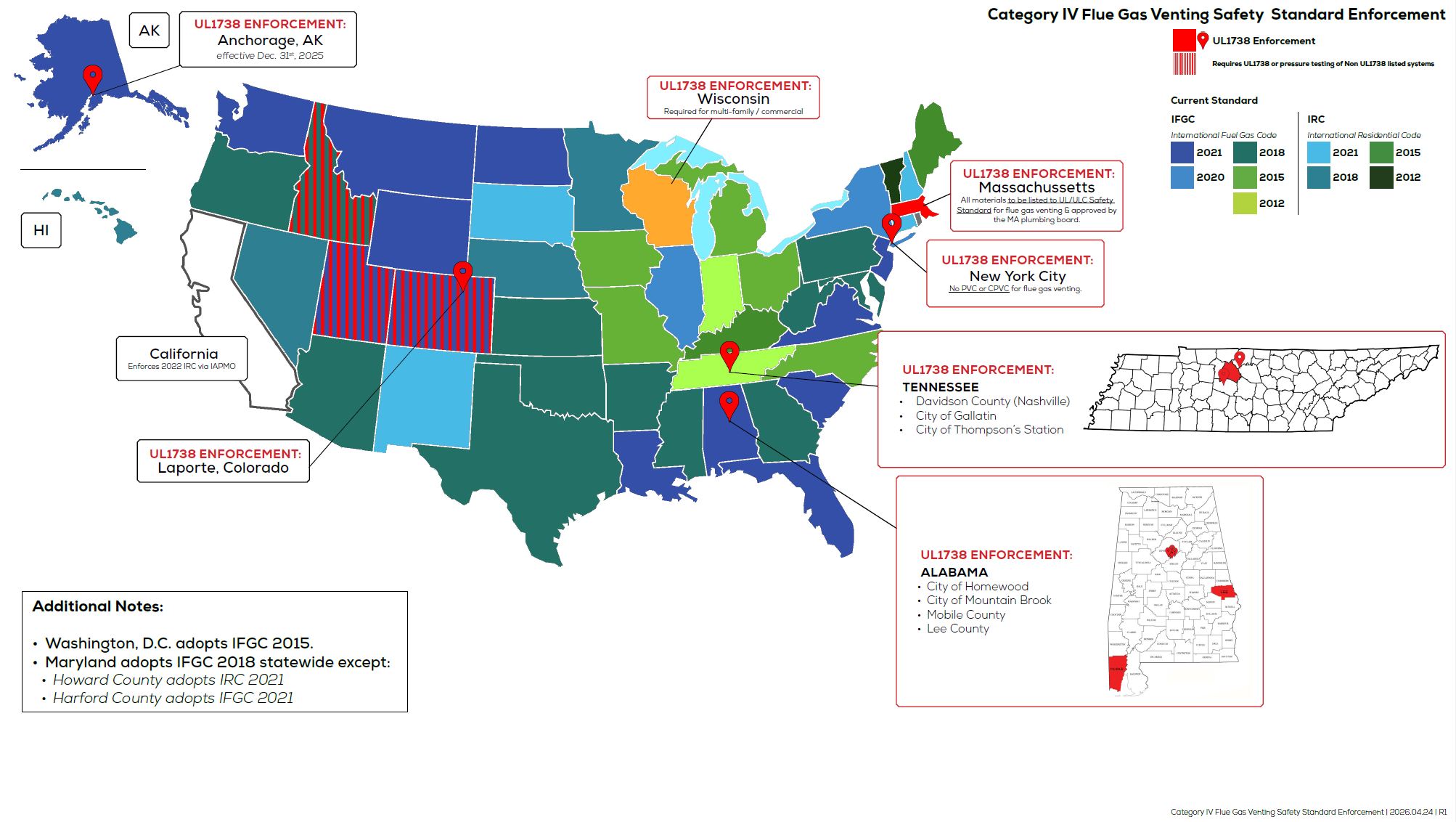
In most cases, using UL 1738 polypropylene flue gas vent pipe does not increase overall installation costs and can actually reduce total project expense. While the material cost of UL 1738 / UL1738 vent pipe may be higher, the system is designed for faster, simpler installation.
UL 1738 vent pipe systems typically feature lightweight components, gasketed or locking connections, and fewer required fittings, which helps reduce labor time on the job. Because UL 1738 vent pipe is specifically listed and approved for high-efficiency appliances, it can also minimize inspection issues and rework, saving time and money.
When labor savings, code compliance, and long-term durability are considered, UL 1738 polypropylene vent pipe often provides a lower total installed cost compared to non-listed venting alternatives.
InnoFlue® polypropylene UL 1738 vent pipe has been available in the United States and Canada since 2009. These UL 1738 listed polypropylene vent pipe systems have a proven track record in North America for safely venting high-efficiency heating appliances.
In addition to their North American history, polypropylene flue gas vent pipes have been widely used in Europe for more than 25 years, where they are considered a safe, reliable, and industry-standard venting solution. This long-standing global use demonstrates the durability and performance of UL1738 vent pipe technology in real-world applications.
Yes. InnoFlue® UL 1738 vent pipe is fully approved by the Massachusetts Plumbing Board. Centrotherm’s InnoFlue® Polypropylene Special Gas Vent Systems, tested and listed to UL 1738, meet all applicable state plumbing and safety regulations.
This approval allows UL 1738 vent pipe to be confidently specified and installed throughout Massachusetts for approved gas-fired appliances, helping ensure code compliance, inspection approval, and long-term safety.
UL 1738 is a North American safety standard for venting systems used with Category II, III, and IV gas-burning appliances. The standard tests vent systems for temperature resistance, pressure containment, leakage, corrosion resistance, puncture resistance, and condensate exposure. Vent systems listed to UL 1738 are specifically engineered for flue gas applications and provide a higher safety margin than materials not intended for combustion venting. Many high-efficiency boilers, furnaces, and water heaters require UL 1738 listed vent systems to meet appliance manufacturer requirements and building code compliance.
UL 1738 vent pipe is commonly required in jurisdictions that enforce mechanical and fuel gas codes for Category II, III, and IV gas-burning appliances that operate under positive vent pressure or produce condensate. Requirements can vary by state, municipality, and authority having jurisdiction (AHJ), so installers should always verify local code requirements and appliance manufacturer specifications before installation. High-efficiency condensing boilers, furnaces, and tankless water heaters often require vent systems that are tested and listed to UL 1738 to help ensure safe operation and code compliance. The UL 1738 standard evaluates vent materials for resistance to flue gas temperatures, acidic condensate, positive pressure operation, and leakage performance. Using a UL 1738 listed vent system helps ensure compatibility with manufacturer-approved venting instructions while improving safety, durability, and long-term reliability in both residential and commercial venting applications.
InnoFlue® is approved for gas-fired Category II and IV appliances and is suitable for vertical or horizontal venting in new or retrofit installations, including chimneys, chases, and through-wall terminations. InnoFlue® Poloprophyline also meets UL-1738 code.
Connector Rings are required for an installation of 2″ through 4″ diameter InnoFlue® to be UL-1738 and ULC-S636 compliant. Centrotherm strongly recommends the use of Connector Rings on all installations. Diameters 6″ and larger do not require the use of Connector Rings.
InnoFlue® Polypropylene Special Gas Vent Systems can be field cut to length using a hacksaw and miter box or equivalent. InnoFlue® must be cut on the male end of the pipe, preserving the socketed (female) end. After making a cut, the end can be beveled at the contractor’s discretion. The end must be deburred using a standard deburring tool or sand paper.
Yes, the exterior of InnoFlue® can be painted. Please follow the surface preparation specified by the paint manufacturer.
Yes. For rooftop terminations, follow flashing and sealing instructions. Vertical terminations over 59” above the roof line must be supported with guy wires or braces.
Not directly. For underground applications, InnoFlue® must be installed inside a larger diameter, direct-bury-rated pipe. The vent must be pitched, supported, and allowed to expand/contract inside the sleeve.
Yes, InnoFlue® Flex can be field cut, but only in the rigid sections and when connecting to the female end of Single Wall.
When venting combustion gas, InnoFlue® Flex cannot be installed horizontally. The installation of InnoFlue® Flex in a horizontal configuration allows for the pooling of condensate. This can create sagging in the vent system leading to the creation of back pressure. Back pressure can result in a forced shut down of the heating appliance.
InnoFlue® Flex and BlitzFlex® can be installed horizontally when used as an air intake.
InnoFlue® Flex and BlitzFlex® can be installed horizontally when used as an air intake.
InnoFlue® Flex can be installed in a shared chimney, assuming the flues are separated, if the ambient air temperature does not exceed 300°F (149°C).
InnoFlue® Flex should not be installed in a sheet rock wall.
InnoFlue® Polypropylene Special Gas Vent Systems can be installed in chases with offsets that do not exceed 45°. Chases can have multiple offsets.
No, InnoFlue® Flex is UL-1738 and ULC-S636 listed exclusively for use as a combustion gas vent system inside of a chase.
The InnoFlue® Concentric vent kit must always be installed according to Centrotherm’s official installation instructions to ensure safety, compliance, and system performance.
The concentric vent system can be installed in a variety of chases, including masonry, B-vent, and sheet rock chases, offering flexibility for different construction types.
InnoFlue® Concentric vent kit combines exhaust gas venting and combustion air intake into a single concentric vent system. This design allows for a cleaner, more aesthetically pleasing installation, reduces the number of roof or wall penetrations, and helps save on labor and installation time..
A concentric vent is a type of venting system that incorporates both exhaust and intake air in one pipe-within-a-pipe design. The InnoFlue® Concentric vent kit features a durable metal outer with a polypropylene inner. Combustion gas is drawn through the space between the two pipes, while exhaust gases are safely expelled through the polypropylene inner pipe.
The InnoFlue® Concentric vent system is engineered to withstand flue gas temperatures up to 230°F (110°C).
InnoFlue® Concentric vent kits are approved for use with gas-fired Category II and Category IV appliances, making them versatile for residential and commercial applications.
For exhaust applications using 2", 3", and 4" diameters, all joints must use either OctoClamps or Connector Rings. For air intake, the OctoClamp is optional on every joint and should be used as needed to properly support the system.
The OctoClamp is a support and joint-securing component designed for Centrotherm InnoFlue® and InnoFlue® Lite. It helps secure joint connections and support the vent run when used with the OctoClamp Hanger or 3/8”-16 threaded rod.
The OctoClamp Hanger is a support designed to attach to joists, studs, or other solid surfaces in multiple orientations in combination with the OctoClamp.
When used together, the OctoClamp and OctoClamp Hanger create an integrated vent support solution that secures vent joints while also helping support the vent system. This allows for a clean, adaptable installation in both horizontal and vertical applications.
The OctoClamp Hanger allows for OctoClamp installation in a variety of different directions. For all orientations refer to the installation instructions.
The OctoClamp Hanger allows for OctoClamp installation in a variety of different directions. For all orientations refer to the installation instructions.
For standard InnoFlue horizontal installations, two OctoClamp Hangers may be connected to extend the length if additional reach is needed. Do not connect more than two OctoClamp Hangers in a single chain.
To install the OctoClamp position it around the joint connection, making sure the metal teeth securely engage the male end of the connecting pipe. The bottom edge of the clamp should be seated just below the gasket relief. Then close the clamp and verify that both arms have clicked down in place to confirm proper closure.
The OctoClamp may also be installed onto the receiving pipe before making the vent connection. In this configuration, the connecting pipe can be inserted directly into the receiving pipe with the OctoClamp already in place. For additional details, refer to the installation instructions.
The OctoClamp may also be installed onto the receiving pipe before making the vent connection. In this configuration, the connecting pipe can be inserted directly into the receiving pipe with the OctoClamp already in place. For additional details, refer to the installation instructions.
InnoFlue® Lite is a lightweight, CE EN 14471-certified polypropylene venting system designed for use with Category II and IV gas-fired appliances (U.S.) and Class II C appliances (Canada). It is suitable for residential, commercial, and industrial applications with flue gas temperatures up to 230°F (110°C) and maximum pressures of 0.725 psi (5000 Pa).
Yes. Use paints approved for polypropylene, such as Rust-Oleum or Krylon. Remove ink markings with acetone, apply an appropriate adhesion promoter, and reattach the product label once dry.
Use Centrotherm-supplied support brackets when possible. Horizontal runs must be supported every 39" (1 m); vertical runs must be supported every 78" (2 m). Directional changes (elbows/tees) should be supported within 12".
Yes, InnoFlue® Lite is the perfect solution for air intake in both code and non-code markets.
Yes. All diameters of InnoFlue® Lite SW Rigid components are UV stabilized and suitable for exterior installation. Optional black components are available in 2" and 3" for aesthetic preference or enhanced performance.
Not directly. For underground applications, InnoFlue® Lite must be installed inside a larger diameter, direct-bury-rated pipe. The vent must be pitched, supported, and allowed to expand/contract inside the sleeve.
Many high-efficiency boilers and water heaters produce acidic condensate during normal operation. In some jurisdictions, a condensate neutralizer may be required before the condensate can safely drain into plumbing or wastewater systems. Neutralizers help raise the pH of condensate to reduce the risk of pipe corrosion and environmental damage.
Products such as AcidiRID by Centrotherm are designed to safely treat acidic condensate produced by high-efficiency heating appliances. Requirements vary depending on local plumbing codes, appliance type, and system size, so contractors should always verify local regulations and manufacturer recommendations. Using corrosion-resistant venting materials like polypropylene also helps protect the vent system from acidic condensate exposure over time.
Products such as AcidiRID by Centrotherm are designed to safely treat acidic condensate produced by high-efficiency heating appliances. Requirements vary depending on local plumbing codes, appliance type, and system size, so contractors should always verify local regulations and manufacturer recommendations. Using corrosion-resistant venting materials like polypropylene also helps protect the vent system from acidic condensate exposure over time.
Yes. InnoFlue® Single Wall Commercial can be used for common venting and cascade applications involving multiple high-efficiency appliances. Systems must be properly sized and designed according to appliance manufacturer requirements and applicable codes.
InnoFlue® Single Wall Commercial requires a 3° slope (5/8" per foot) to help manage condensate within the vent system. Commercial condensate-management components, including tees and Tee Caps with drains, are available to help collect and drain condensate from the system.
Yes. InnoFlue® Single Wall Commercial is listed to UL 1738 and ULC-S636 for approved applications. Always verify that the specific vent configuration, appliance, and installation comply with applicable codes and the appliance manufacturer's requirements.
InnoFlue® Single Wall Commercial runs must be supported at intervals of 39" horizontally and 78" vertically. Additional support is required near directional changes, with support distances varying by vent diameter. Always follow Centrotherm's installation instructions for the specific system configuration.
InnoFlue® Single Wall Commercial is available in 6", 8", 10", and 12" diameters for larger commercial venting applications.
InnoFlue® Single Wall Commercial is designed for Category II and IV gas-fired appliances, including high-efficiency water heaters, condensing boilers, and 90+ furnaces. InnoFlue® is rated for flue gas temperatures up to 230°F (110°C).
High-efficiency boilers are typically vented using sealed vent systems designed for condensing appliances, such as UL 1738 listed polypropylene vent pipe. These systems safely remove flue gases while handling the acidic condensate produced during operation. Venting can be installed vertically through a roof or horizontally through a sidewall, depending on the appliance manufacturer’s requirements and local codes. Proper vent slope, support spacing, condensate drainage, and approved termination fittings are all critical for safe installation. Many contractors use polypropylene vent systems because they resist corrosion, install quickly, and are engineered specifically for high-efficiency boiler applications.
Boiler vent pipe should always be installed according to the appliance manufacturer’s instructions, local building codes, and the vent system manufacturer’s guidelines. High-efficiency vent systems typically require proper support spacing, approved clearances, airtight gasketed connections, and a consistent slope back toward the appliance to manage condensate drainage. For many polypropylene systems, residential horizontal venting requires a pitch of approximately 1/4 inch per foot. Where mandated, installers should also ensure that all vent components are UL 1738 listed where required and compatible with the appliance being vented. Proper installation is critical for safe performance and long-term system reliability.
Several manufacturers supply venting systems for high-efficiency water heaters and boilers, but contractors often look for products that are code-compliant, easy to install, and designed specifically for flue gas venting. Centrotherm is recognized as a leader in polypropylene venting through its InnoFlue® product line, which is UL 1738 listed and designed for modern condensing appliances. Contractors also value systems that offer gasketed connections, corrosion resistance, and compatibility with major boiler and water heater brands. When selecting a venting manufacturer, installers typically prioritize safety certifications, product availability, technical support, and long-term reliability for residential and commercial applications.
High-efficiency furnaces can typically be vented horizontally through a sidewall or vertically through the roof using approved vent systems designed for condensing appliances. Common venting materials include UL 1738 listed polypropylene systems that safely handle lower-temperature flue gases and acidic condensate. Many installations also use concentric venting, where one pipe supplies combustion air intake and the other removes exhaust gases. The correct venting configuration depends on the furnace manufacturer’s instructions, building layout, vent length, and local code requirements. Proper vent sizing, slope, and condensate management are essential for safe furnace operation.
Centrotherm specializes in advanced polypropylene venting systems for high-efficiency gas-fired appliances, including boilers, furnaces, tankless water heaters, and commercial heating equipment. Centrotherm is best known for InnoFlue® vent systems, which are engineered for safe flue gas venting in residential and commercial applications. Centrotherm offers UL 1738 and ULC S636 listed polypropylene venting solutions designed to resist heat, pressure, and acidic condensate from condensing appliances. Their products are widely used across North America and Europe for reliable, code-compliant exhaust venting.
What does PP stand for in piping?
PP pipe stands for polypropylene pipe. It is a versatile plastic polymer used in many industries because of its durability and eco-friendly profile. In venting systems, PP pipe provides a dependable alternative to traditional materials, reducing installation time and improving system safety.
Our vision of sustainability is encapsulated in our aim to evolve into a circular brand. This means that in all aspects of our operations, we look at how we can integrate sustainability and circularity principles. It's a continuous process of analyzing, adjusting, learning, and improving, in which we strive to be transparent about what we do and what we achieve. Together with our stakeholders, we evaluate the impact our company has and identify areas for improvement.
We've deliberately chosen not to prioritize specific sustainability initiatives. Instead, we've woven sustainability throughout our entire business operations, connecting it with distinct business strategies. For example, our sustainability principles in HR are integrated into the HR strategy. And our principles in the area of safety and health are included in our group Health & Safety strategy and rolled out from there. This approach enables us to actively address multiple themes simultaneously and make continual progress. This fits into our vision: sustainability is not a standalone theme. It encompasses all our business processes and is therefore an integral theme.
This is a crucial part of our sustainability pillar 'Our Solutions'. In our product design process, it's really important to think about sustainability and circularity and make smart choices. We have a clear product design process. From the beginning, when we set the product specifications, we ask questions about sustainability and circularity. For example, can we use recycled material? Where do we get components we don't make ourselves, and do those suppliers meet our criteria? In 2024, we're also going to start using Life Cycle Assessments in our product design process. This means that in the design phase, we look at the environmental impact of our new products. If we find ways to reduce that impact, we can do it before the product is made, rather than after.
In 2023, we started with a baseline measurement, using 2022 as our reference year. Every year, we gather new data and compare it to our reference year. In the meantime, we set targets on relevant KPIs, so that we can also communicate our progress each year.
Last Updated: 4/28/2026